
BIBLE VERSES ABOUT INCLUSIVITY
Introduction
In today’s world, where cultures, opinions, and backgrounds vary widely, the idea of inclusivity stands as both a social value and a biblical principle. The Bible teaches that all people are created in the image of God and therefore deserve love, dignity, and respect. In a time when division and exclusion often dominate public conversations, believers are reminded that the message of Christ calls everyone into unity and fellowship under His grace.
Inclusivity in the Christian faith does not mean compromising truth or accepting sin. Rather, it means recognizing that God’s salvation is available to all who believe, regardless of race, gender, status, or past mistakes. Scripture consistently points to a God who breaks down barriers and invites all people into relationship with Him through Jesus Christ. Let us explore several powerful Bible verses about inclusivity, what they reveal about God’s heart, and how believers can live out these truths in daily life.
God Created All People in His Image
The foundation of inclusivity begins in Genesis. From the very start, God declared the equal value of every human being.
Related Posts:

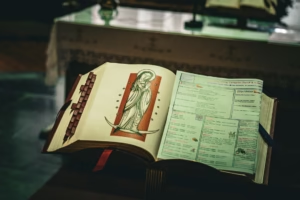


Genesis 1:27 says, “So God created mankind in His own image, in the image of God He created them; male and female He created them.”
This verse reveals that no one is inherently superior or inferior. Every person bears the divine imprint of the Creator. That truth alone makes discrimination or exclusion incompatible with Christian living. When we see others as image bearers of God, we are called to treat them with respect, compassion, and grace.
In practical terms, this means refusing to judge people by appearances, social class, or background. It challenges believers to love others as Christ loves us, acknowledging that worth is derived from being God’s creation, not from human labels.
Jesus Welcomed the Outcast
One of the most striking characteristics of Jesus’ earthly ministry was His willingness to embrace those considered unworthy by society. The Gospels show Jesus reaching out to lepers, tax collectors, and sinners.
In Luke 19:10, Jesus declares, “For the Son of Man came to seek and to save the lost.” His mission was inclusive. He crossed cultural and social lines to bring hope to everyone.
The story of the Samaritan woman in John 4:7-26 is another example. Jesus engaged in meaningful conversation with a woman who was marginalized both for her ethnicity and her moral failures. Yet, He offered her living water, symbolizing eternal life and acceptance.
Jesus’ inclusive love challenges the church today. Believers are called to break barriers, to invite those who feel unwanted or forgotten, and to communicate the same message of redemption that Jesus shared.
The Church as One Body
Inclusivity is not only a moral value but also a spiritual reality within the body of Christ. The Apostle Paul repeatedly emphasized unity among believers despite differences.
Galatians 3:28 declares, “There is neither Jew nor Gentile, neither slave nor free, nor is there male and female, for you are all one in Christ Jesus.”
This verse teaches that in Christ, divisions lose their power. The church is meant to be a family where every member has equal value and purpose. Paul’s imagery of one body with many parts in 1 Corinthians 12 further emphasizes that each person, regardless of background or gift, contributes to the growth and function of the whole.
When believers practice inclusivity in their local churches, they reflect God’s kingdom. There is beauty in diversity. It reveals the creativity of God and reinforces that everyone has a place in His plan.
God Shows No Favoritism
Inclusivity also flows from God’s impartial character. The Bible makes it clear that God does not show favoritism or partiality based on external factors.
Acts 10:34-35 records Peter saying, “I now realize how true it is that God does not show favoritism but accepts from every nation the one who fears Him and does what is right.”
This revelation came at a pivotal time in early church history. Peter realized that Gentiles, who had been seen as outsiders by many Jews, were equally invited to receive the Holy Spirit and salvation.
God’s acceptance extends to all who seek Him sincerely. As Christians, we are called to mirror that same attitude of impartiality. Prejudice, whether racial, cultural, or social, has no place in a heart transformed by grace.
Inclusivity in Loving Our Neighbor
Jesus summarized the entire law in two commands: love God and love your neighbor. Inclusivity naturally flows from this principle.
Matthew 22:39 says, “Love your neighbor as yourself.” This commandment does not allow for exceptions. Every person we encounter becomes a neighbor in the eyes of God.
The parable of the Good Samaritan in Luke 10:25-37 reinforces this truth. The Samaritan, who belonged to a group despised by Jews, was the one who acted with compassion. Jesus used that story to teach that love transcends cultural boundaries.
True inclusivity means extending kindness, hospitality, and understanding to others, even when they are different from us. It reflects the inclusive love of Christ that reached out to every sinner and offered grace without partiality.
Practical Ways to Live Out Biblical Inclusivity
Inclusivity is more than belief. It must be practiced daily. As followers of Christ, we can cultivate inclusive hearts in several ways.
- See people through God’s eyes. Remember that every person is made in His image and has inherent worth.
- Serve without discrimination. Whether in church, work, or community, extend help and friendship equally.
- Listen and learn. Understanding the experiences of others fosters empathy and unity.
- Pray for humility. Ask God to reveal any bias or judgment that prevents genuine love.
- Model God’s love. Live in such a way that others can see Christ’s inclusive nature reflected through your actions.
When believers live inclusively, the church becomes a radiant testimony of God’s unconditional love and grace to the world.
Key Lessons
- God values every human equally because all are made in His image.
- Jesus modeled inclusivity by welcoming the marginalized and offering salvation to everyone.
- The church is one body in Christ without distinction or favoritism.
- God’s nature is impartial, and His grace extends across every boundary.
- Loving our neighbor means embracing people of all backgrounds with Christlike compassion.
Conclusion
Inclusivity is not just a social trend. It is a biblical truth deeply rooted in the character of God and the ministry of Jesus Christ. From creation to the early church and beyond, Scripture reveals a consistent message of unity, equality, and love for all people.
As believers, we are called to reflect this truth in our words, relationships, and communities. By embracing others as Christ embraced us, we reveal the heart of the Gospel, a message of reconciliation and peace for all nations. May we strive to live as inclusive followers of Christ, drawing people toward His grace and showing the world what it truly means to belong to the family of God.
Further Reading
BIBLE VERSES ABOUT BLACK PEOPLE
BIBLE VERSES ABOUT LATENESS TO CHURCH
BIBLE VERSES ABOUT GOD PROTECTING US FROM OUR ENEMIES