
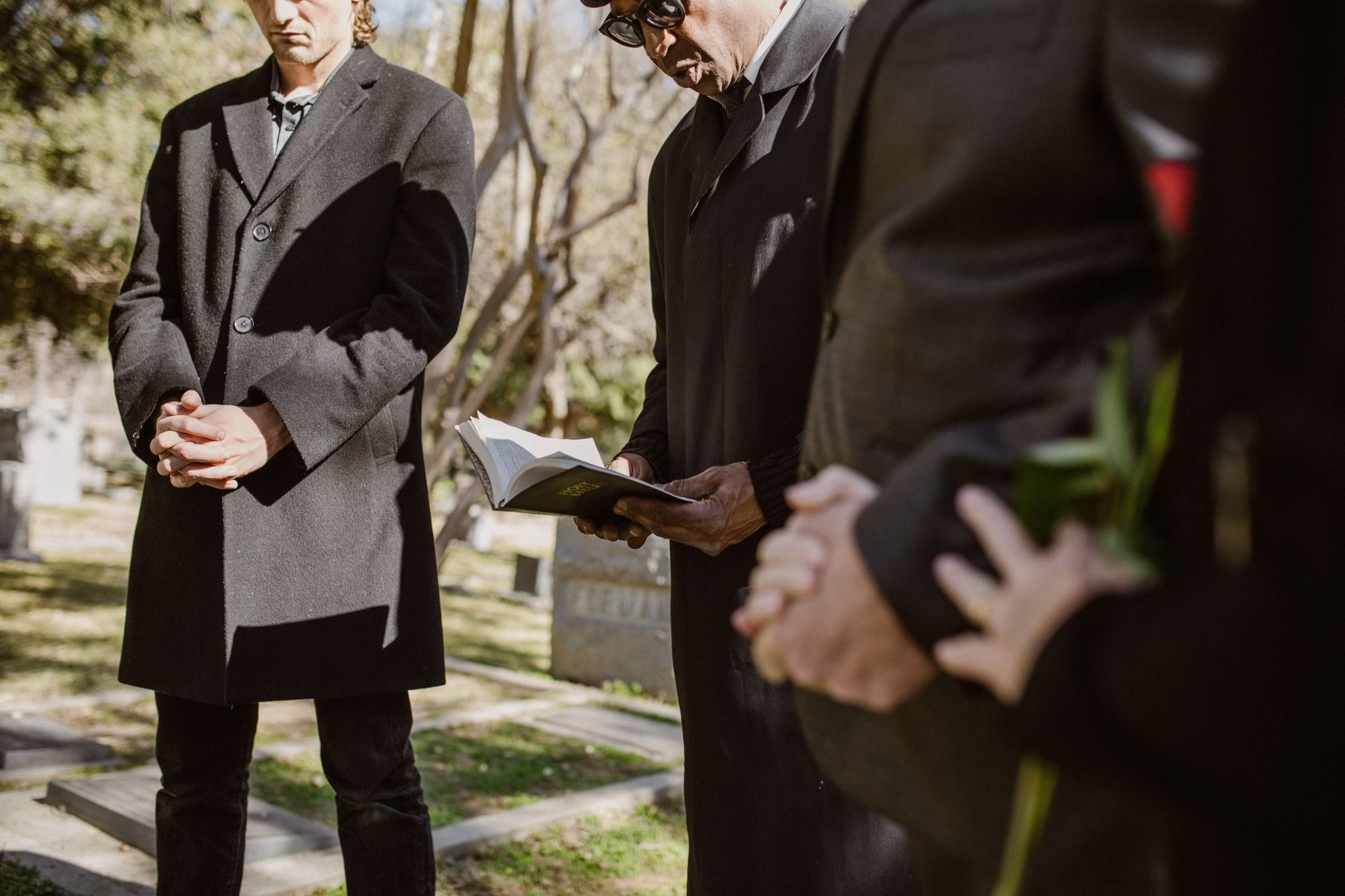
The Multi-Faceted Language of the Soul
For many believers, prayer can easily collapse into a single pattern: sitting down, offering a brief word of thanks, and then moving straight into a list of requests. While God delights in hearing our needs, reducing our prayer life to mere petition overlooks the sheer depth of fellowship offered to us in Christ. The Bible presents prayer not as a rigid ritual or a simple wish list, but as a rich, multi-roomed home where the soul meets its Creator in every season and emotional state.
When the apostle Paul instructed his young protege Timothy on the foundational practices of the gathered church, he did not treat prayer as a uniform, one-size-fits-all activity. Instead, he highlighted its distinct expressions:
“First of all, then, I urge that supplications, prayers, intercessions, and thanksgivings be made for all people” – 1 Timothy 2:1
By identifying these different forms, Scripture invites us to expand our spiritual vocabulary. Understanding the distinct nuances of prayer enables us to approach God with greater freedom, honesty, and alignment with His Word. Whether we are overflowing with joy, weighed down by grief, burdened for a friend, or longing for personal transformation, God’s Word provides the language we need.
Adoration: Gazing Upon God’s Character
Adoration is the act of praising God simply for who He is, independent of what He has done for us in a particular moment. It is the language of holy wonder. In adoration, our eyes turn away from our own circumstances, limitations, and immediate desires, fixing instead on the transcendent beauty, holiness, sovereignty, and mercy of God.
This form of prayer is vital because it reorders our internal world. Left to ourselves, our problems tend to loom large, filling the entire horizon of our minds. Adoration places God back at the center of our gaze, reminding us of His infinite power and eternal goodness. When we adore God for His attributes—His faithfulness, His majesty, His unchanging love—our trust in Him naturally deepens.
The Psalmist models this posture when inviting the congregation to approach God with a heart attuned to His character:
“Enter his gates with thanksgiving, and his courts with praise; give thanks to him and praise his name.” – Psalm 100:4
Adoration requires no hidden agenda. It does not ask for anything; it simply responds to the splendor of the God who is worthy of all honor. Making room for adoration at the start of our prayers reshapes our hearts, establishing a foundation of awe and reverence before we bring our earthly concerns to the throne.
Thanksgiving: Recognizing God’s Generous Hand
While adoration focuses on God’s eternal character, thanksgiving responds to His specific acts of kindness, mercy, and provision in our lives. It is the conscious exercise of memory, choosing to recognize and name the blessings God has bestowed upon us. Thanksgiving guards the human heart against two subtle spiritual dangers: pride and entitlement.
Without a practice of thanksgiving, we easily begin to credit our own efforts for our success, or we grow resentful over the things we feel we lack. Thanksgiving shifts our perspective from scarcity to abundance. It acknowledges that every good gift comes from the Father above, cultivating humility and joy.
Scripture consistently connects thanksgiving with inner peace and freedom from anxiety. Paul highlights this essential link when writing to the church at Philippi:
“do not be anxious about anything, but in everything by prayer and supplication with thanksgiving let your requests be made known to God.” – Philippians 4:6
Notice that thanksgiving is not intended to be a posture we adopt only after our prayers are answered. It is a present-tense stance woven directly into our requests. Even in the midst of uncertainty, we can give thanks for God’s past faithfulness and His ongoing promises, knowing He remains steadfast.
Confession and Lament: Bringing Brokenness into the Light
A mature prayer life must leave room for sorrow, vulnerability, and honest acknowledgment of our frailty. Two biblical forms of prayer address our pain and our failure directly: confession and lament.
1. Confession
Confession is the honest agree-with-God prayer regarding our sin. It is not an exercise in self-loathing or a desperate attempt to persuade a reluctant God to love us. Rather, confession is the clearing away of the debris that disrupts our fellowship with Him. God already sees our hearts completely; confession is simply our step into the light of His truth.
“If we confess our sins, he is faithful and just to forgive us our sins and to cleanse us from all unrighteousness.” – 1 John 1:9
When we confess, we lean into the mercy purchased for us at the cross. We step out of hiding, relinquish our self-righteousness, and receive the restoring grace that renews our joy in salvation.
2. Lament
Alongside confession stands lament—a category of prayer that modern believers often overlook. Over a third of the Psalms are prayers of lament, where God’s people express raw grief, confusion, and sorrow over suffering, hardship, or injustice. Far from being a sign of weak faith, biblically grounded lament is a profound act of trust. It brings our deepest pain directly to God rather than walking away from Him in bitterness. Lament brings our questions and heartache to the Lord, trusting that He is big enough to handle our grief and faithful enough to hold us through it.
Petition and Intercession: Carrying Needs Before the Throne
God invites us to bring our personal needs and the needs of others to Him with boldness. The Bible distinguishes between two distinct directions of request: petition and intercession.
Petition refers to presenting our own needs before God. Jesus taught us to pray, “Give us this day our daily bread,” affirming that God cares about our daily physical, emotional, and spiritual sustenance. Bringing our desires to God in petition is an admission of our dependence on Him. It honors God by treating Him as the true source of wisdom, strength, and daily grace.
Intercession, on the other hand, is the act of standing in the gap for others. When we intercede, we carry the burdens, illnesses, struggles, and spiritual needs of our neighbors, families, churches, and world to God’s throne of grace. Intercession is love on its knees. It requires us to step outside our self-absorption and actively care for the spiritual and temporal well-being of those around us.
Scripture assures us that praying for one another carries genuine weight in the spiritual realm:
“Therefore, confess your sins to one another and pray for one another, that you may be healed. The prayer of a righteous person has great power as it is working.” – James 5:16
Cultivating an Integrated Life of Prayer
Understanding these different forms of prayer is not meant to turn our quiet time into a rigid, mechanical routine where we must check off every box before moving on. Rather, these expressions serve as a helpful framework to expand our communion with God, ensuring our spiritual lives remain balanced and vibrant.
Some days will call for extended seasons of lament and confession; other days will spill over with exuberant praise and thanksgiving. In moments of crisis, our prayers may consist primarily of desperate petitions or fervent intercession for a loved one. By recognizing all of these biblical streams, we are freed from the pressure of praying perfectly and invited simply to commune authentically with our heavenly Father.
The apostle Paul sums up this rich, continuous posture of communion in his letter to the Ephesians:
“praying at all times in the Spirit, with all prayer and supplication.” – Ephesians 6:18
As you approach God today, allow Scripture to expand your horizon. Rest in the knowledge that your Heavenly Father welcomes your praise, honors your gratitude, pardons your confessed sin, holds your sorrow, and delights to answer your prayers.











18 Comments
This post beautifully outlines the various ways we can connect with God through prayer 🙏🏿🙏🏿🙏🏿. I love how each type of prayer serves a different purpose, but they all ultimately deepen our relationship with Him. I’m especially encouraged by the reminder to practice adoration, something I often forget in my own prayer life.
I completely agree with you! Adoration is something I often overlook too. It’s so important to remember that prayer isn’t just about asking for things but also about praising God for who He is. I’m definitely going to work on making that a regular part of my prayers as well ❤❤❤❤❤❤❤❤❤
I’ve always wondered how to make my prayers more meaningful, and this post answered so many questions. I’m going to start using a prayer journal to help me with adoration and thanksgiving. Thank you for such a practical and encouraging post
Thank you for breaking down the different types of prayer ❤❤. I’ve always struggled with consistency in my prayer life, but seeing these distinct categories gives me a clearer understanding of how I can structure my prayers. I’m going to start incorporating more thanksgiving and supplication into my daily routine.
Your comment adds a great personal touch, Ethan! You’ve shared how the post is motivating you to enhance your prayer life, which is encouraging for others reading. I like how you acknowledged the struggle and shared your action plan, it’s relatable and constructive.
This post really opened my eyes to how diverse prayer can be. I love the emphasis on intercession and corporate prayer. It’s amazing to think that we can pray not only for ourselves but for others too, and God hears us. Such a powerful reminder
Sarah, your comment highlights the diversity of prayer beautifully! Your focus on intercession and corporate prayer emphasizes the communal aspect of faith, which adds depth to the discussion. Your enthusiasm for praying for others is inspiring.
I’ve never considered meditation as part of prayer before, but it makes so much sense! Reflecting on God’s Word is an important way to hear from Him. I’m going to make more time for meditation during my devotions. Thank you for this insightful post 🙏🏿🙏🏿🙏🏿🙏🏿🙏🏿🙏🏿🙏🏿🙏🏿🙏🏿🙏🏿🙏🏿🙏🏿
Noah, you’ve touched on an often overlooked aspect, meditation in prayer! I appreciate how you’re drawing attention to the importance of reflecting on God’s Word. Your comment feels insightful and opens up the conversation about different ways to hear from God.
I appreciate this breakdown of the types of prayer. I often get stuck just asking for things (supplication), but now I realize I need to include adoration and thanksgiving more often. This was a great reminder to balance my prayer life!
Grace, your comment is reflective and constructive. Acknowledging the balance between adoration, thanksgiving, and supplication is insightful. Your honesty about focusing more on asking in prayers will resonate with many readers, making your comment valuable.
This post is incredibly helpful! I didn’t know there were so many types of prayer. The section on corporate prayer especially spoke to me. I’m going to be more intentional about praying with others, there’s so much strength in community.
Such a helpful guide! I love how each form of prayer has its own importance. I’ve been neglecting confession in my prayers lately, and this post reminded me of how crucial it is to acknowledge my sins before God. Thank you for the wisdom shared here!
I love how you explained the different forms of prayer. It’s easy to get into a routine and forget that prayer can take many shapes. The concept of meditation was especially eye-opening for me, definitely something I need to incorporate into my quiet time.
This was such a refreshing read! I’ve been struggling with how to pray more effectively, and this post gave me practical ways to grow in my prayer life. I’m going to focus on intercession and standing in the gap for others more consistently.
Really am edified in the spirit with such a beautiful teaching about various types of prayer. I bless the Lord, thank you.
Glory to God! 🙏 I’m so glad it blessed you, may the Lord continue to strengthen you in prayer.