Rooted in Heavenly Blessings: Your True Identity
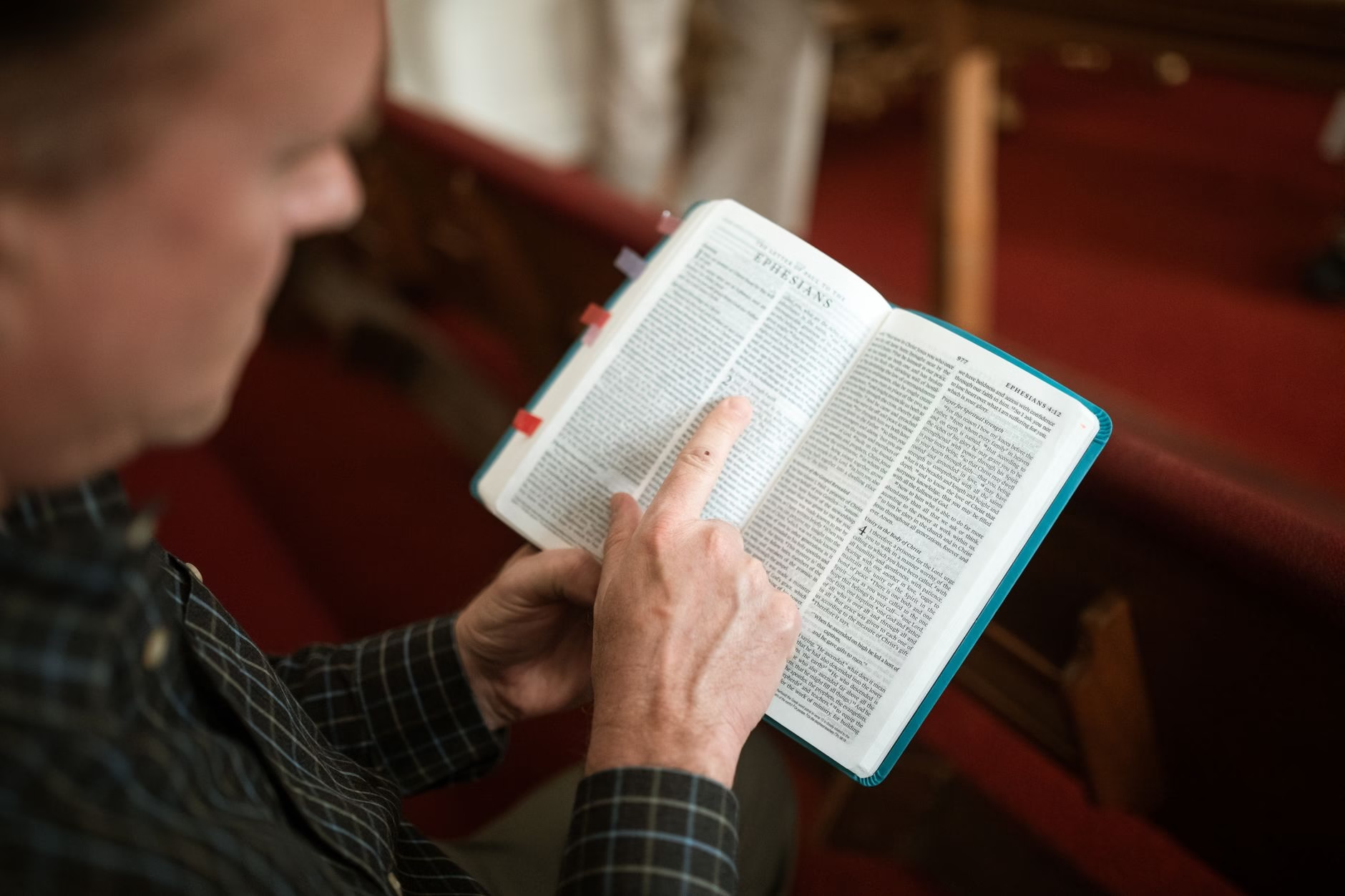
Few books in Holy Scripture speak as directly to the human heart’s longing for belonging as the Apostle Paul’s letter to the Ephesians. Written from a prison cell in Rome, Paul opened his heart to a church situated in a wealthy, pagan city, reminding them—and us—that our ultimate identity is not determined by our earthly circumstances, our achievements, or our failures. Instead, our true identity is anchored in the unseen reality of God’s sovereign grace.
In the opening chapter, Paul breaks into a song of praise, reminding believers that before the world was framed, God intended to bring us into His family. He writes:
“Blessed be the God and Father of our Lord Jesus Christ, who has blessed us in Christ with every spiritual blessing in the heavenly places, even as he chose us in him before the foundation of the world, that we should be holy and blameless before him.” – Ephesians 1:3-4
To be “in Christ” means that every blessing necessary for your soul’s peace and eternal security has already been secured. When life feels unstable or uncertain, the Christian does not need to search for worth in human approval. God has already claimed you, adopted you, and lavished His favor upon you through Jesus Christ.
Rescued by Grace: The Gift That Undermines Self-Reliance
Human nature longs to earn its keep. We prefer to think that our good deeds, moral uprightness, or religious devotedness put God in our debt. But the second chapter of Ephesians gently dismantles our spiritual pride by painting an honest portrait of our condition apart from Christ. We were not merely struggling or sick; spiritually, we were completely dead in our transgressions.
The turning point of the entire epistle rests on two breathtaking words at the start of chapter two: “But God.” God looked upon our helpless state not with disdain, but with boundless compassion. Paul captures this gospel truth in these memorable words:
“For by grace you have been saved through faith. And this is not your own doing; it is the gift of God, not a result of works, so that no one may boast. For we are his workmanship, created in Christ Jesus for good works, which God prepared beforehand, that we should walk in them.” – Ephesians 2:8-10
Salvation is entirely a work of divine mercy. The word translated as “workmanship” carries the idea of a masterpiece—a work of divine artistry. You are God’s crafted creation, saved not by your good works, but saved for good works that bring honor to His name.
Walking Worthy: Living Out Unity in the Body
Having spent the first three chapters unfolding rich, foundational theology, Paul turns his attention in chapter four to practical Christian living. Theology is never meant to sit quietly in the intellect; it must walk on two feet into our homes, workplaces, and local churches. Paul issues a tender yet firm exhortation regarding how believers ought to treat one another:
“I therefore, a prisoner for the Lord, urge you to walk in a manner worthy of the calling to which you have been called, with all humility and gentleness, with patience, bearing with one another in love, eager to maintain the unity of the Spirit in the bond of peace.” – Ephesians 4:1-3
Notice that Paul calls us to maintain unity, not to manufacture it. Christ has already unified His people at the cross, knocking down the dividing walls of hostility. Our responsibility is to reflect that reality in our daily interactions. This requires four specific Christian virtues:
- Humility: Recognizing our own utter dependence on God’s grace, which keeps us from looking down on others.
- Gentleness: Exercising strength under control, approaching wounded souls with tenderness rather than harshness.
- Patience: Refusing to lose temper or give up on people who are still growing and learning.
- Forbearance: Patiently bearing with the flaws and idiosyncrasies of our brothers and sisters in Christ.
Putting On the New Self: Practical Holiness
Transformation in Christ involves a continual process of putting off old habits of sin and putting on the habits of grace. Paul uses the picture of changing clothes. We are no longer to wear the worn-out, stained garments of our former way of life; instead, we are called to be clothed in Christ’s righteousness.
This daily transformation touches every area of our conduct—especially our speech and our attitudes toward those who hurt us. Paul offers a clear standard for Christian speech and relationships:
“Let no corrupting talk come out of your mouths, but only such as is good for building up, as fits the occasion, that it may give grace to those who hear… Be kind to one another, tenderhearted, forgiving one another, as God in Christ forgave you.” – Ephesians 4:29, 32
Consider the power of those words. Every time we speak, our words either build up those around us or tear them down. And when conflict arises—as it inevitably does—the standard for our forgiveness is not whether the offender deserves it, but how lavishly God in Christ has already forgiven us.
Standing Firm: Equipping for Spiritual Struggle
Paul closes his letter by lifting the veil on the invisible spiritual reality that surrounds us. The Christian life is not a playground; it is a battleground. Yet Paul does not leave us to fight in our own fragile strength. He directs us to the power of our almighty Father:
“Finally, be strong in the Lord and in the strength of his might. Put on the whole armor of God, that you may be able to stand against the schemes of the devil.” – Ephesians 6:10-11
The armor Paul describes—truth, righteousness, the gospel of peace, faith, salvation, and the Word of God—is actually a description of Christ Himself. To put on the armor of God is simply to hide yourself in Jesus, taking refuge in His finished work and relying on His Spirit through constant, watchful prayer.
As you reflect on the message of Ephesians, take heart. You are loved with an everlasting love, chosen by grace, placed within a redeeming community, and equipped by God’s own power to stand fast in every trial.