
BIBLE VERSES ABOUT ESAU
Introduction
The story of Esau is one of the most intriguing and thought-provoking accounts in the Bible. Found primarily in the Book of Genesis, his life paints a vivid picture of choices, consequences, and God’s sovereign plan. Esau, the firstborn son of Isaac and Rebekah, was the twin brother of Jacob. He is often remembered for selling his birthright for a bowl of stew, yet there is much more to his story than this one moment of weakness.
For believers today, Esau’s journey offers valuable lessons about priorities, perseverance, forgiveness, and the importance of spiritual discernment. By studying the Bible verses about Esau, we can uncover wisdom that helps us live more faithfully, avoid spiritual short-sightedness, and understand how God’s plans unfold through both blessings and mistakes.
The Birth and Character of Esau
The story of Esau begins in Genesis 25. Even before his birth, Scripture highlights that his life would be marked by struggle.
Related Posts:



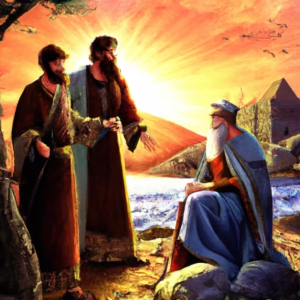
Genesis 25:22-23 says, “The babies jostled each other within her, and she said, ‘Why is this happening to me?’ So she went to inquire of the Lord. The Lord said to her, ‘Two nations are in your womb, and two peoples from within you will be separated. One people will be stronger than the other, and the older will serve the younger.’”
From the beginning, God revealed that two great nations would emerge from Rebekah’s womb, and that the older, Esau, would serve the younger, Jacob. Esau grew up to be a skillful hunter, a man of the field, while Jacob was a quiet man who stayed close to home.
This contrast in personality is important. Esau lived driven by immediate physical needs and passions, whereas Jacob sought after spiritual blessings, though imperfectly. Esau’s impulsive nature eventually led to choices that changed the course of his destiny.
The Sale of the Birthright
One of the most well-known moments in Esau’s life occurs in Genesis 25:29-34. Famished from the field, Esau came to Jacob and demanded some stew. Jacob replied, “First sell me your birthright.” Esau answered, “Look, I am about to die, what good is the birthright to me?” He then swore an oath and sold it to Jacob for a simple meal.
The birthright represented not only material inheritance but also the spiritual promise God gave to Abraham and Isaac. Esau’s decision reveals how little he valued the blessings of God compared to the satisfaction of his immediate hunger.
Hebrews 12:16 warns believers about this same kind of attitude: “See that no one is sexually immoral, or is godless like Esau, who for a single meal sold his inheritance rights as the oldest son.”
This verse teaches that Esau’s actions symbolized spiritual carelessness. He represents those who trade eternal blessings for temporary satisfaction. In today’s world, believers face similar temptations whenever they prioritize worldly pleasure or convenience over faithfulness to God.
The Deception and Lost Blessing
Genesis 27 describes how Jacob, urged by his mother Rebekah, deceived his father Isaac into blessing him instead of Esau. Isaac, who was old and nearly blind, unknowingly conferred the covenant blessing upon Jacob.
When Esau returned and discovered what had happened, the Bible says in Genesis 27:34, “When Esau heard his father's words, he burst out with a loud and bitter cry and said to his father, ‘Bless me, me too, my father!’”
Esau’s anguish reveals deep regret. Yet he did not show repentance in turning back to God. Instead, anger filled his heart, leading him to vow revenge against his brother. Although his pain was understandable, his reaction demonstrated how resentment can poison relationships and distance us from the peace God desires for us.
Later, the New Testament again refers to Esau’s sorrow in Hebrews 12:17: “Afterward, as you know, when he wanted to inherit this blessing, he was rejected. Even though he sought the blessing with tears, he could not change what he had done.”
This is a sobering reminder that our choices carry lasting consequences. Genuine repentance involves more than regret. It means turning back to God with humility and obedience.
Esau’s Forgiveness and Reconciliation
Despite all the pain and betrayal, Esau’s story does not end in bitterness. Years after Jacob fled from his anger, the two brothers finally met again. Genesis 33 records this moving reunion.
When Jacob saw Esau approaching with four hundred men, he was terrified. But to his surprise, Esau ran to meet him, embraced him, and wept. Their reconciliation is one of the most touching scenes in Scripture.
Genesis 33:4 states, “But Esau ran to meet Jacob and embraced him, he threw his arms around his neck and kissed him, and they wept.”
This act of forgiveness shows that God can transform even the hardest hearts. Although Esau is often seen as a warning figure, here he becomes an example of grace and reconciliation. God desires every believer to let go of resentment and choose forgiveness, just as Esau did.
The Legacy of Esau
After reconciling with Jacob, Esau went on to father the nation of Edom. Throughout the Old Testament, the descendants of Esau, the Edomites, often opposed the Israelites. Yet God’s Word also reveals that He dealt with each nation according to His perfect justice.
Malachi 1:2-3 records God’s words, “I have loved Jacob, but Esau I have hated.” This expression does not refer to hatred in the emotional sense but rather indicates God’s chosen plan of covenant through Jacob’s line. Esau’s story reminds us of God’s sovereignty and justice, and how He chooses according to His divine purpose, not human merit.
Although Esau’s descendants frequently struggled against Israel, Scripture still acknowledges his blessings. Deuteronomy 2:4-5 shows that God respected Esau’s inheritance: “Give the people these orders: You are about to pass through the territory of your relatives the descendants of Esau who live in Seir. Do not provoke them to war, for I will not give you any of their land.”
This reveals that while Esau lost the covenant blessing, God still showed him mercy. His story displays both the seriousness of spiritual neglect and the enduring fairness of God’s dealings.
Key Lessons from Esau’s Life
Esau’s life is full of lessons that remain relevant for every believer:
• Value spiritual blessings more than temporary satisfaction.
• Guard against impulsive choices that lead to lasting consequences.
• Repent quickly when you fall short, rather than allowing regret to harden your heart.
• Seek forgiveness and be willing to forgive others.
• Trust in God’s sovereign plan, even when you do not fully understand it.
Conclusion
The Bible verses about Esau challenge us to look deeper into our own hearts. His story illustrates how one moment of weakness can redefine a life, yet it also reveals how forgiveness and grace can bring restoration. Esau reminds every believer of the need to put eternal priorities first, to walk in humility, and to allow God’s plan to guide every choice.
Let his story inspire you to cherish the spiritual inheritance offered through Jesus Christ. The blessings of God are of far greater worth than anything the world can offer. By choosing faith over impulse and forgiveness over bitterness, we walk the path of true spiritual maturity and peace.
Further Reading
BIBLE VERSES ABOUT BLACK PEOPLE
BIBLE VERSES ABOUT LATENESS TO CHURCH
BIBLE VERSES ABOUT GOD PROTECTING US FROM OUR ENEMIES