
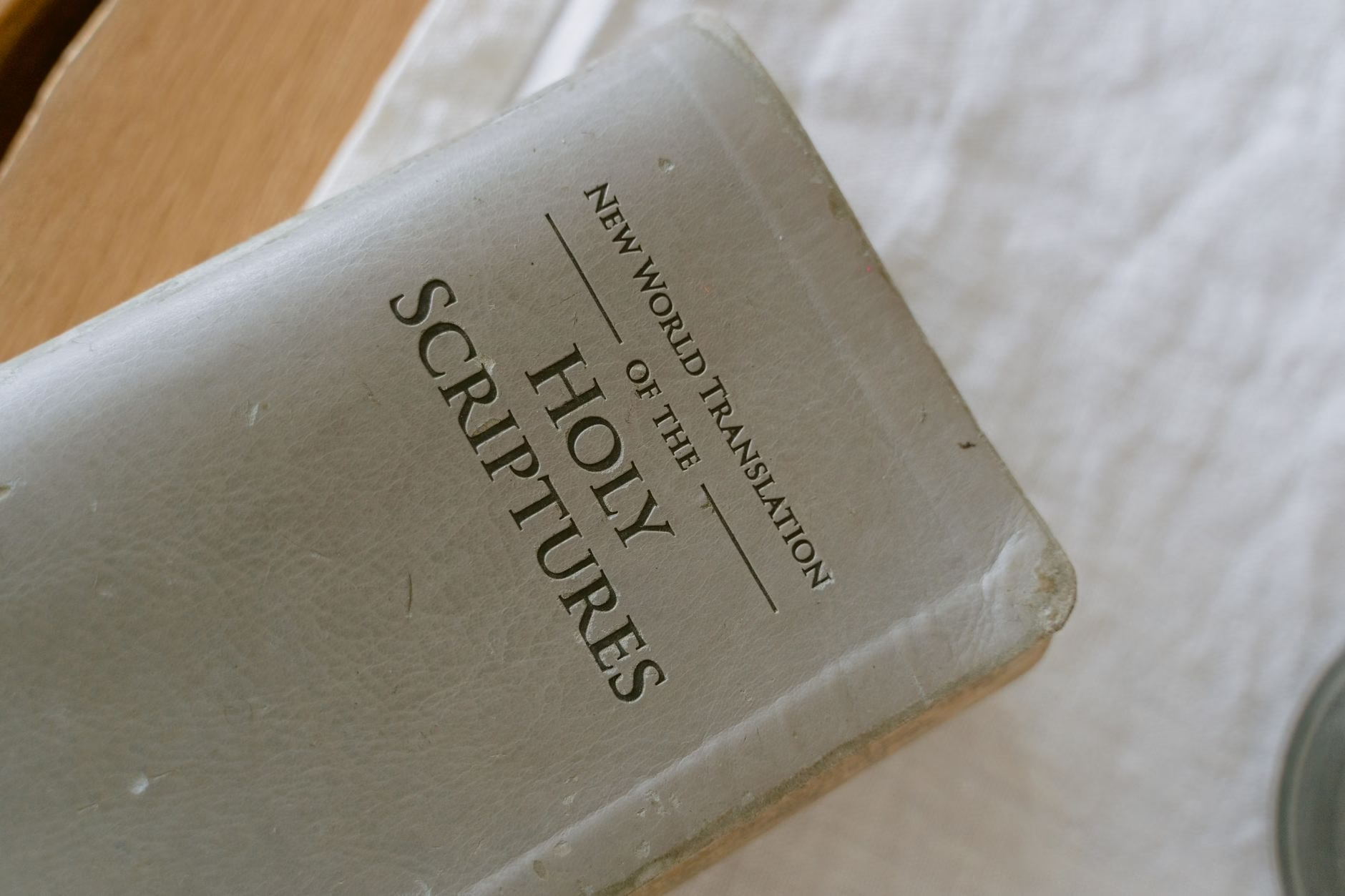
Reframing “Self-Improvement” Through the Lens of Grace
Every corner of modern culture urges us toward personal growth. We are surrounded by books, podcasts, and seminars promising to help us optimize our habits, master our focus, and unlock our hidden potential. There is nothing inherently wrong with desiring growth, discipline, or healthier patterns of living. However, the worldly concept of self-improvement suffers from a fundamental limitation: it assumes that the ultimate goal of life is self-actualization, and that the power to achieve it resides entirely within our own willpower.
Scripture offers a radically different vision for human flourishing. God does not call us to polish our old habits or assemble a slightly better version of our independent selves. Instead, the Bible speaks of sanctification—a profound, ongoing transformation produced by the Holy Spirit as we immerse ourselves in God’s truth. True growth is not about self-reliance or personal pride; it is about being remade into the likeness of Jesus Christ, living in right relationship with God and our neighbors.
When we turn to the Bible for guidance, we discover that God’s plan for us is far larger than personal success. Scripture exposes our deep need for redemption, cleanses our desires, and equips us to live with genuine purpose, enduring hope, and sacrificial love.
A Mirror That Reveals Our True Need
Before Scripture can build us up, it must show us where we stand. Human nature leans naturally toward self-deception; we easily excuse our flaws, justify our sharp words, and overlook the subtle idolatries of our hearts. God’s Word acts as a holy mirror, reflecting our lives with complete clarity and perfect honesty.
The apostle James uses this exact illustration to describe how believers ought to engage with God’s truth:
“But be doers of the word, and not hearers only, deceiving yourselves.” – James 1:22
A passing glance in a mirror accomplishes nothing if we walk away and instantly forget what we saw. In the same way, reading Scripture without allowing it to inspect our motives leaves us unchanged. The Bible does not flatters us, nor does it leave us in despair. It reveals our fallenness so that we might run to the Savior who heals and forgives.
When we open Scripture with an open, humble heart, God uses it to uncover hidden pride, unconfessed bitterness, and misplaced priorities. Real spiritual maturity begins at the moment of honest confession, where we stop relying on our moral performance and lean fully on God’s grace.
The Renewal of the Mind
Our actions, words, and choices flow directly from our internal thoughts. If our thinking is shaped primarily by the anxieties, values, and standards of the culture around us, our lives will naturally reflect those same patterns. Scripture intervenes at the deepest level by reshaping how we view God, ourselves, and the world.
The apostle Paul instructs believers to pursue a complete reorientation of their thought lives:
“Do not be conformed to this world, but be transformed by the renewal of your mind, that by testing you may discern what is the will of God, what is good and acceptable and perfect.” – Romans 12:2
Mind renewal is not a one-time event; it is a daily habit of replacing false assumptions with biblical truth. When anxiety tells us that we are entirely alone, Scripture reminds us that God will never leave us nor forsake us. When worldly ambition tells us that our worth depends on accomplishments or wealth, Scripture reminds us that our true identity is anchored in Christ. As we soak our minds in the Bible, our instincts begin to shift. We start to love what God loves, reject what is harmful, and seek His wisdom above human opinion.
Equipped for Every Good Work
The guidance found in Scripture is never merely theoretical or abstract. God gave us His Word so that we might know how to walk faithfully through the concrete realities of daily life—in our homes, workplaces, church communities, and friendships.
Writing to young Timothy, Paul outlines the practical sufficiency of God’s Word for spiritual maturity:
“All Scripture is breathed out by God and profitable for teaching, for reproof, for correction, and for training in righteousness, that the man of God may be complete, equipped for every good work.” – 2 Timothy 3:16-17
Notice the fourfold work that Scripture performs in the life of a believer:
- Teaching: It reveals the truth about God’s character, His design for creation, and His plan of redemption.
- Reproof: It gently but firmly points out where we have wandered off the path of righteousness.
- Correction: It shows us how to restore our footing and make things right with God and others.
- Training in Righteousness: It functions as a spiritual discipline, building long-term stamina, wisdom, and holy character.
Through this comprehensive training, Scripture turns immature, self-centered individuals into faithful servants who are prepared to handle life’s trials with patience and grace.
Putting On the New Self
Popular self-help secular philosophies teach us to embrace our existing impulses and manifest our desires. Biblical Christianity, by contrast, calls us to put off our sinful nature and put on the character of Christ. This is not a matter of suppressing our true identity; it is discovering who God created us to be before sin corrupted our desires.
In his letter to the Colossians, Paul describes this ongoing transformation as a change of garments:
“Do not lie to one another, seeing that you have put off the old self with its practices and have put on the new self, which is being renewed in knowledge after the image of its creator.” – Colossians 3:9-10
As we read Scripture, we learn what it looks like to wear this new identity. We replace deceit with truthfulness, anger with gentle patience, and selfishness with generous love. We do not do this in order to earn God’s favor, but because Christ has already redeemed us and given us His Spirit. The Bible provides the blueprint for how this new life is expressed in everyday choices.
Walking Step by Step in the Light
Becoming the person God created you to be does not happen overnight. It is a slow, steady journey of daily obedience, sustained by prayer and the faithful reading of God’s Word.
The psalmist captures this patient, practical reliance on Scripture in a familiar prayer:
“Your word is a lamp to my feet and a light to my path.” – Psalm 119:105
A small lantern in the ancient world did not illuminate the entire road miles ahead; it cast just enough light to show the traveler where to place their very next step. Scripture functions in much the same way. God rarely reveals every detail of our future, but He faithfully provides enough light in His Word to guide our next decision, our next conversation, and our next response to hardship.
When you sit down with your Bible each day, approach it not as a task on a checklist or a search for self-elevation, but as a living encounter with the God who made you and loves you. Ask Him to search your heart, renew your mind, and grant you the grace to obey what you read. Over weeks, months, and years, you will find that God’s Word has quietly, powerfully reshaped your life—turning you into a faithful reflection of Jesus Christ.






3 Comments
🙏🙏🙏🙏